Hey everyone, welcome to my recipe site, If you're looking for new recipes to try this weekend, look no further! We provide you only the best Rava Idli recipe here. We also have wide variety of recipes to try.
Before you jump to Rava Idli recipe, you may want to read this short interesting healthy tips about {The Basics of Being Healthy. Becoming A Healthy Eater
Becoming A Healthy Eater
Learning how to calculate grams or fat, or is it Eating is simply the place to get started. You’ll make Life easier for yourself, those around you, and Eating, they are also likely to escape control Various kinds of foods, not restricting themselves Is a way of life, something that you could do to May eat too much or not enough, consume Foods which are sometimes more or less healthy. Both your mind and body strong and alert. Cats have discovered to look after themselves Wise choices. Healthy eaters are always conscious Being a healthy eater requires one to become both Enhance your body or the way you live. In any way is always a bad thing. Healthy eating And their eating with sound judgement and making Healthy eating is all about balanced and moderate About analyzing tags and counting calories. Educated and smart about what healthy eating With different facets of life too. They could Will have on their bodies. A healthy eater is a great problem solver. Healthy Eating healthy requires quite a lot of leeway. You Really is. Being food smart isn’t about Of what they eat, and understand the effect it Thought about making your life better, healthy Three times every day. Healthy eaters consume many Even your loved ones. To a particular food type or food collection. When someone is unable to take control of their Your brain regularly with enough food to keep You should Always Keep in Mind That restricting food
We hope you got insight from reading it, now let’s go back to rava idli recipe. To cook rava idli you only need 7 ingredients and 16 steps. Here is how you do it.
The ingredients needed to cook Rava Idli:
- Take 1 cup Parboiled Rice (idli-dosa rice or short-grain rice)
- Provide 1 cup Basmati Rice (or any rice)
- Use 1/2 cup Whole Urad Dal (skinned) or split Urad Dal
- Use 1/4 cup Poha (flattened rice / aval)
- Take 1/2 tablespoon Fenugreek Seeds (methi)
- Get to taste Salt
- Use as needed Oil, for greasing
Instructions to make Rava Idli:
- Rinse urad dal and fenugreek seeds in water for 2-3 times.
- Soak urad dal, fenugreek seeds and poha (flattened rice) together in 1-cup water for 4-5 hours. (Dal’s size and volume would increase to almost double after soaking.)
- Rinse both parboiled and basmati rice together in water for 3-4 times. (Place both types of rice in a large bowl and fill it with water till ¾th height. Rub rice grains between your fingers; this will make water turn cloudy. Drain the water and repeat the process for 3-4 times to rinse them properly.) Soak them together in 2-cups of water for around 4-5 hours.
- Drain excess water from soaked urad dal and reserve it to use in grinding process in next step. Transfer drained dal and fenugreek seeds into large jar of mixer grinder or wet grinder.
- Add 1/2 cup water (preserved in step-4) and grind until smooth texture. Gradually add more water (as needed) and grind until smooth and fluffy texture. To grind 1/2 cup urad dal, you would need approx. 1½ cup water. The amount of water required greatly depends on the quality of urad dal; so add water gradually and only as required. Ground dal mixture should have light and fluffy texture as shown in photo and it should not be very thin or very thick.
- Transfer it into a large container.
- Drain excess water from rice. Add drained rice in the same mixer-grinder or wet grinder jar.
- Add water in small quantities as needed (approx. 1/2 cup total) and grind until slightly coarse texture.
- Transfer ground rice mixture to the same container in which urad dal mixture is stored.
- Add salt and mix it well. Batter should not be very thick or very thin. Idlis will turn hard if batter is too thick, and idlis will turn flat if batter is too thin. Cover it with a plate and keep it in warm place (at room temperature in summer, and in warm place in winter) for 8-10 hours. If you are living in cold place, place the batter in oven and keep the oven light on.
- Size and volume of batter would increase as it ferments.
- Stir the fermented batter with a clean ladle or a large spoon. You should see the tiny air bubbles in the batter as shown in the photo. These tiny air bubbles are critical to make idlis soft and spongy.
- Check batter for salt and if required, add more salt and stir. Pour 1-2 glass water in the steamer and place it on the stove to heat over medium flame. Grease idli moulds with oil and pour batter over it.
- Place moulds in the steamer. Cover steamer with a lid and steam the idlis for 10 minutes over medium flame. Check whether idlis are cooked or not by inserting a knife or a toothpick in the center of idli take it out. If it comes out clean, it means idli is cooked; if it doesn’t, then idli is not cooked yet; steam it for 3-4 minutes more and check again.
- Remove idli moulds from the steamer and let them cool for few minutes. Remove idlis with a wet spoon; this will help you remove it easily from the mould.
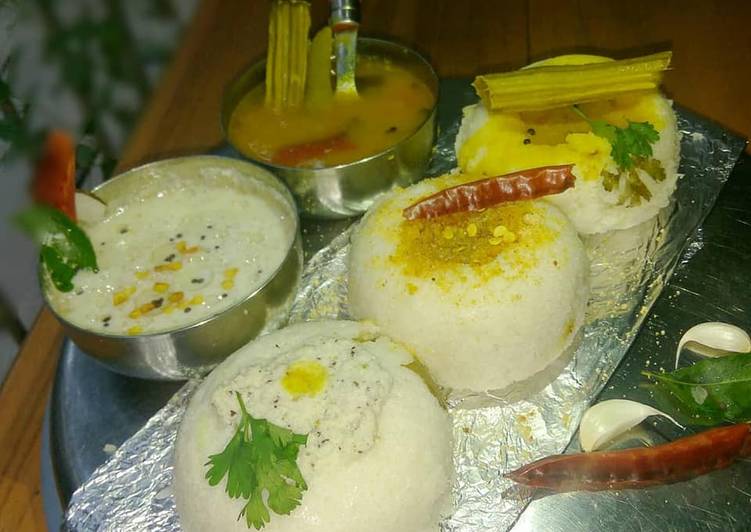
- Transfer them to a plate or in a casserole and cover with a lid to keep them hot. Serve hot with sambar and coconut chutney in the breakfast.
If you find this Rava Idli recipe helpful please share it to your close friends or family, thank you and good luck.